The short answer
A useful Digital SAT diagnostic should identify skill gaps, timing behavior and confidence, not just produce a score. A short diagnostic is a starting estimate; a current full-length adaptive test is the better benchmark for score planning and stamina.
Key facts
- A diagnostic only works if it is full length and taken under real time limits.
- The useful output is a skill breakdown, not a single score.
- Free official full-length tests are available in the College Board's Bluebook app.
- Take the diagnostic before studying, or it measures your preparation instead of your baseline.
Measure three different problems
Content knowledge, process and timing can produce the same wrong answer. A useful report separates them enough to suggest a next action.
| Signal | What it answers | Useful next action |
|---|---|---|
| Skill accuracy | Which domains repeat as weak? | Focused concept and question sets |
| Time per question | Where does the session slow down? | Recognition and skip practice |
| Error pattern | Why are points being lost? | Knowledge, process or execution repair |
Know what a short diagnostic cannot establish
A 15-minute sample can quickly surface obvious gaps, but it cannot reproduce two hours of stamina, both adaptive pathways or every content domain. Treat its projected score as an estimate with uncertainty.
Use a full-length official or properly calibrated digital test before making a final test-date or score-submission decision.
Make the result more useful
Use a laptop or tablet, work without outside help and resist pausing the clock. Honest conditions make even a short result more useful. Record interruptions or technical problems so they are not mistaken for academic gaps.
- Use the calculator rules allowed on the real test.
- Guess rather than leaving a question blank.
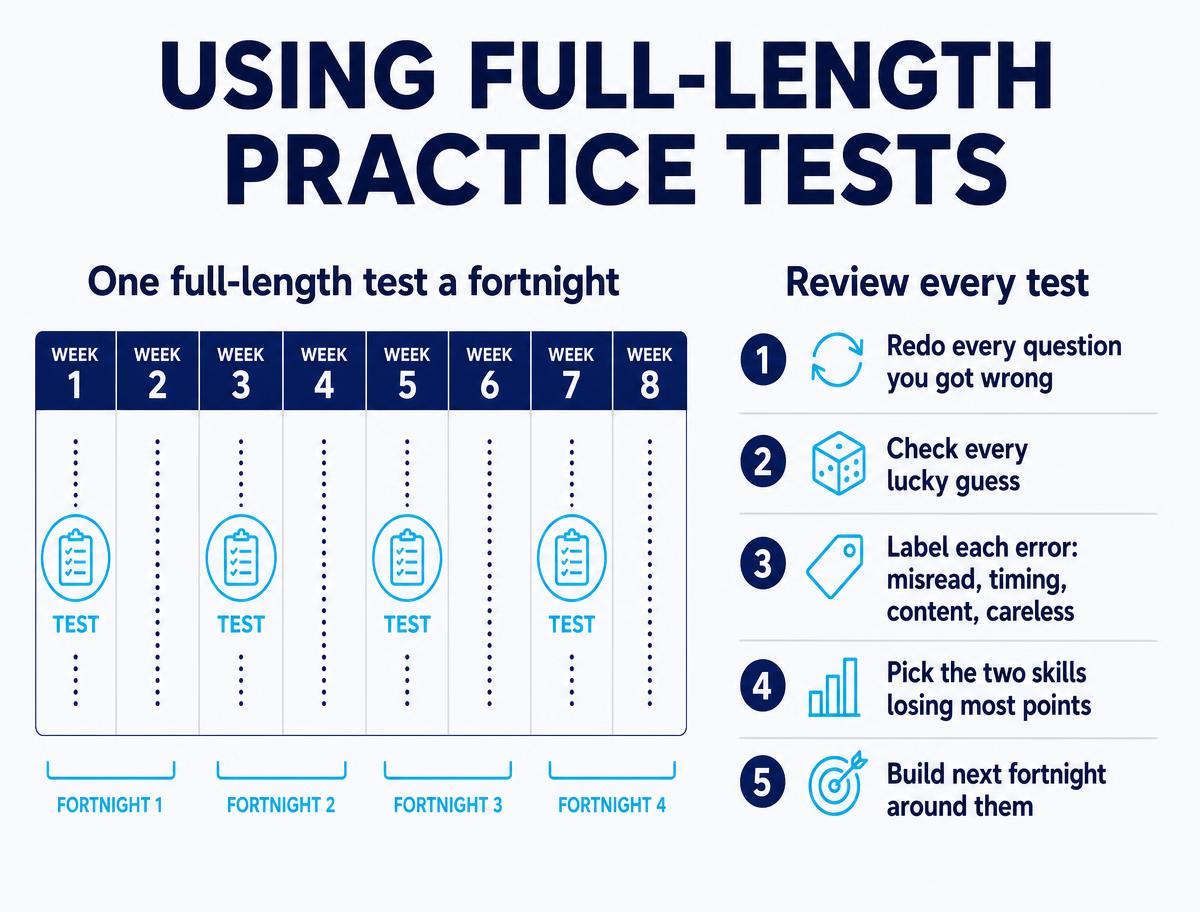
- Review the reason for each miss before taking another test.
Use the first 48 hours well
Choose no more than two priority skills from the report. Review the underlying method, solve fresh untimed examples, then finish with a short mixed timed set. The diagnostic earns its value only when it changes the next practice session.
Translate a diagnostic into the next session
Suppose a short diagnostic flags algebra and grammar while a full-length Bluebook test also shows late-module Math guesses. Study the content gaps, but do not ignore the pacing signal: a short diagnostic cannot measure two hours of stamina or the adaptive pathway.
Choose one content area and one process issue for the next few sessions. After working fresh questions, take another timed set and ask whether both accuracy and pacing improved. Do not mistake a flattering short projected score for an official full-length result.
- Label each missed question by content, process or timing.
- Prioritize patterns that repeat across the full-length test.
- Use official Bluebook tests as the measurement benchmark.
Questions people ask
- What should a Digital SAT diagnostic measure?
- Accuracy by skill, time spent per question, and how performance changes across the second module. A score alone tells you almost nothing about what to do next. The breakdown is the part worth having.
- Where can I get a free one?
- The College Board publishes free full-length adaptive practice tests inside Bluebook, the same app used on test day. That combination of free, official and realistic is hard to beat as a starting point.
- What do I do with the result?
- Pick the two or three skills responsible for the largest share of lost points and build your first two weeks around them. Ignore skills where you lost one mark. Retest under timed conditions in two weeks to see if the work transferred.
Digital SAT format and practice
More in this series
Sources and further reading
Your next useful step
Turn this guide into focused practice.
How this guide is made
Sourced, reviewed and clear about uncertainty.
The ExamScore Editorial Team checks exam facts against the primary sources listed in each guide, labels ExamScore recommendations as guidance, and updates material when official formats or policies change. We do not publish guaranteed score gains.
Continue reading