The short answer
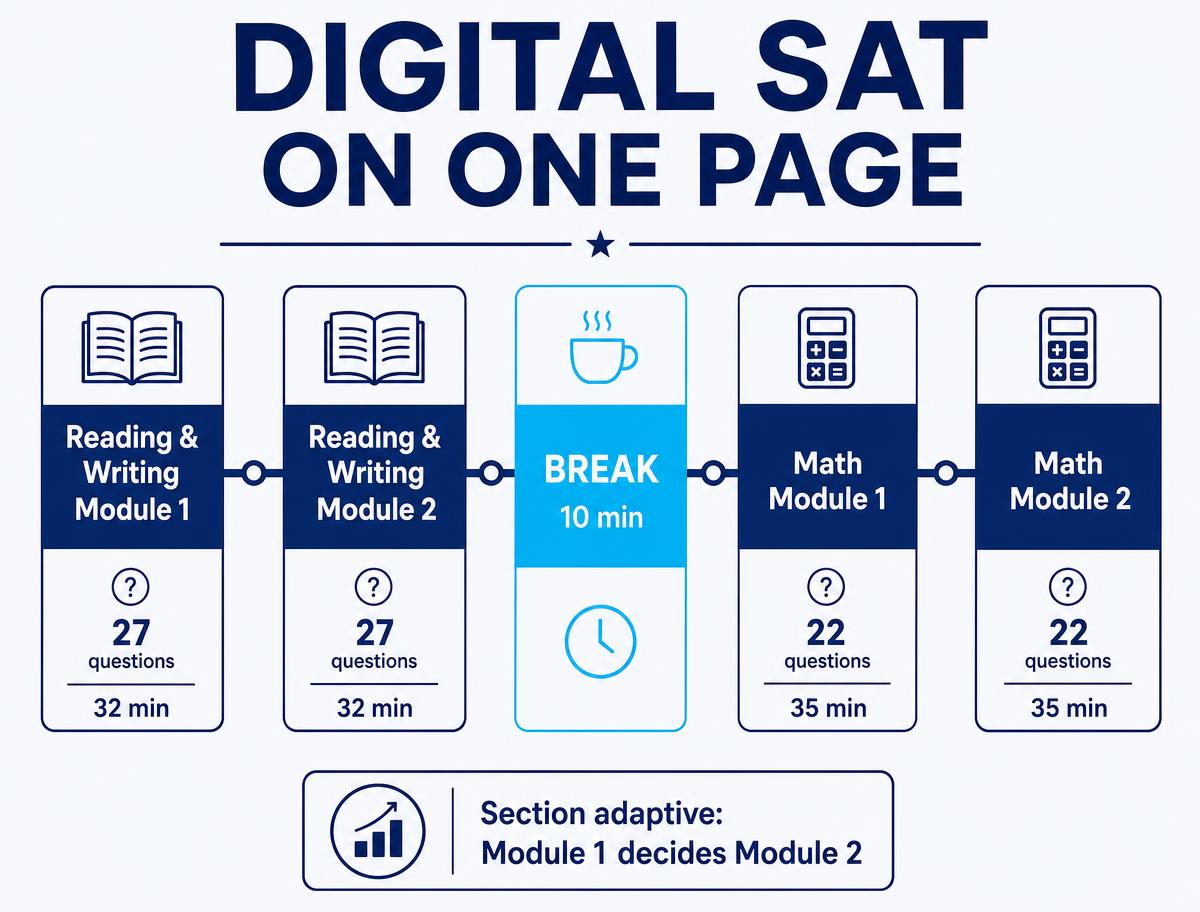
The Digital SAT lasts 2 hours 14 minutes and has two sections: Reading and Writing, then Math. Each section has two modules. Performance in the first module helps determine the difficulty mix in the second, so a paper worksheet cannot fully reproduce the test experience.
Key facts
- The Digital SAT is taken in the College Board's Bluebook app, not on paper.
- It has two sections, Reading and Writing then Math, and each section is split into two modules.
- The test is section adaptive: how you do in module one decides the difficulty of module two.
- A built-in Desmos graphing calculator is available throughout the Math section.
Digital SAT format at a glance
The test is shorter than the former paper SAT and combines reading and writing into one section. A ten-minute break separates the two sections.
| Section | Questions | Time | Modules |
|---|---|---|---|
| Reading and Writing | 54 | 64 minutes | 2 × 32 minutes |
| Math | 44 | 70 minutes | 2 × 35 minutes |
| Total | 98 | 2 hours 14 minutes | 4 modules + break |
What two-stage adaptive testing means
Everyone begins with a broad mix of questions in module one. Based on that performance, module two presents a different difficulty mix. This is section-level adaptivity, not a question changing immediately after every answer.
You can move among questions inside the current module, but you cannot return after the module ends. That makes review decisions and end-of-module timing part of the skill being tested.
“A harder second module is not a score by itself. The final score uses the difficulty and response pattern across both modules.”
The interface is part of preparation
Bluebook includes a countdown timer, question navigator, flag-for-review control, annotation tools and a built-in Desmos calculator for Math. Students may use an approved handheld calculator too, but calculator use is permitted throughout the Math section.
Good digital practice includes scrolling, opening the calculator, flagging, returning and reading from a screen under time pressure. Printable questions can teach content, but not this workflow.
- Practice with the timer visible and hidden.
- Learn when Desmos is faster than hand calculation.
- Use the question navigator to plan the final review minute.
Combine official practice with targeted repair
Use official Bluebook tests to measure full-test performance because they reproduce the delivery system. Between those tests, use targeted practice to fix the skills and timing decisions the result exposed.
Do not burn through full official tests too quickly. A test is most valuable after the previous one has been reviewed and the recurring mistakes have been addressed.
Rehearse the screen, not just the questions
The official test runs in Bluebook: Reading and Writing has 54 questions in 64 minutes, Math has 44 in 70 minutes, and there is a ten-minute break between sections. Each section contains two timed modules. You can move within a module but cannot revisit it after time expires.
Before a full practice test, try flagging a question, using the on-screen tools and returning to a marked item. This separates an interface problem from a content problem. Use the current official Bluebook practice tests to rehearse the full sequence rather than assuming a paper worksheet will feel the same.
- Practice moving between questions within a module.
- Know where the timer, mark-for-review control and Math calculator are.
- Save questions you cannot start quickly for a second pass within the same module.
Questions people ask
- How long is the Digital SAT?
- Roughly two hours and fourteen minutes of testing time, plus a break between the two sections. That is about an hour shorter than the old paper test, mainly because there are fewer questions and shorter reading passages.
- What does section adaptive mean in practice?
- Your performance in the first module of a section decides which second module you get. A stronger first module routes you to a harder second module, which is what makes the top of the score range reachable. Both routes are scored fairly.
- Can I skip questions and come back?
- Yes, within the module you are working on. Bluebook lets you flag questions and review them before the module ends. Once a module closes you cannot return to it, so do your reviewing before time runs out.
Digital SAT format and practice
More in this series
Sources and further reading
Your next useful step
Turn this guide into focused practice.
How this guide is made
Sourced, reviewed and clear about uncertainty.
The ExamScore Editorial Team checks exam facts against the primary sources listed in each guide, labels ExamScore recommendations as guidance, and updates material when official formats or policies change. We do not publish guaranteed score gains.
Continue reading