The short answer
AI can make test prep more targeted by explaining missed questions, identifying repeated patterns and suggesting what to practice next. It cannot replace official practice or your own judgment. No tool can promise a higher score.
Key facts
- AI tools explain quickly but can be confidently wrong, so explanations need checking.
- Official practice material remains the reference point for what real questions look like.
- An explanation only counts once you can solve a fresh question without it.
- AI is weakest where a human tutor is strongest: accountability and motivation.
Not every AI study tool does the same job
A chatbot that answers a prompt, an adaptive practice system and an analytics engine solve different problems. Before trusting the label, ask what information the system uses and whether its recommendation connects to actual performance.
| Tool type | Useful for | Watch for |
|---|---|---|
| General chatbot | Alternative explanations and questions | Confident but incorrect answers; no test history |
| Adaptive practice | Choosing difficulty or skills from responses | Unclear calibration or non-exam-like questions |
| Performance analytics | Finding repeated timing and topic patterns | Overinterpreting a small sample |
| AI tutor | Guided review and next-step suggestions | Advice that cannot show its reasoning or source |
Where AI can genuinely help
AI is strongest when it reduces search and organization work: grouping errors, comparing solution methods, turning a score report into a short practice queue, or explaining the same concept in a different way.
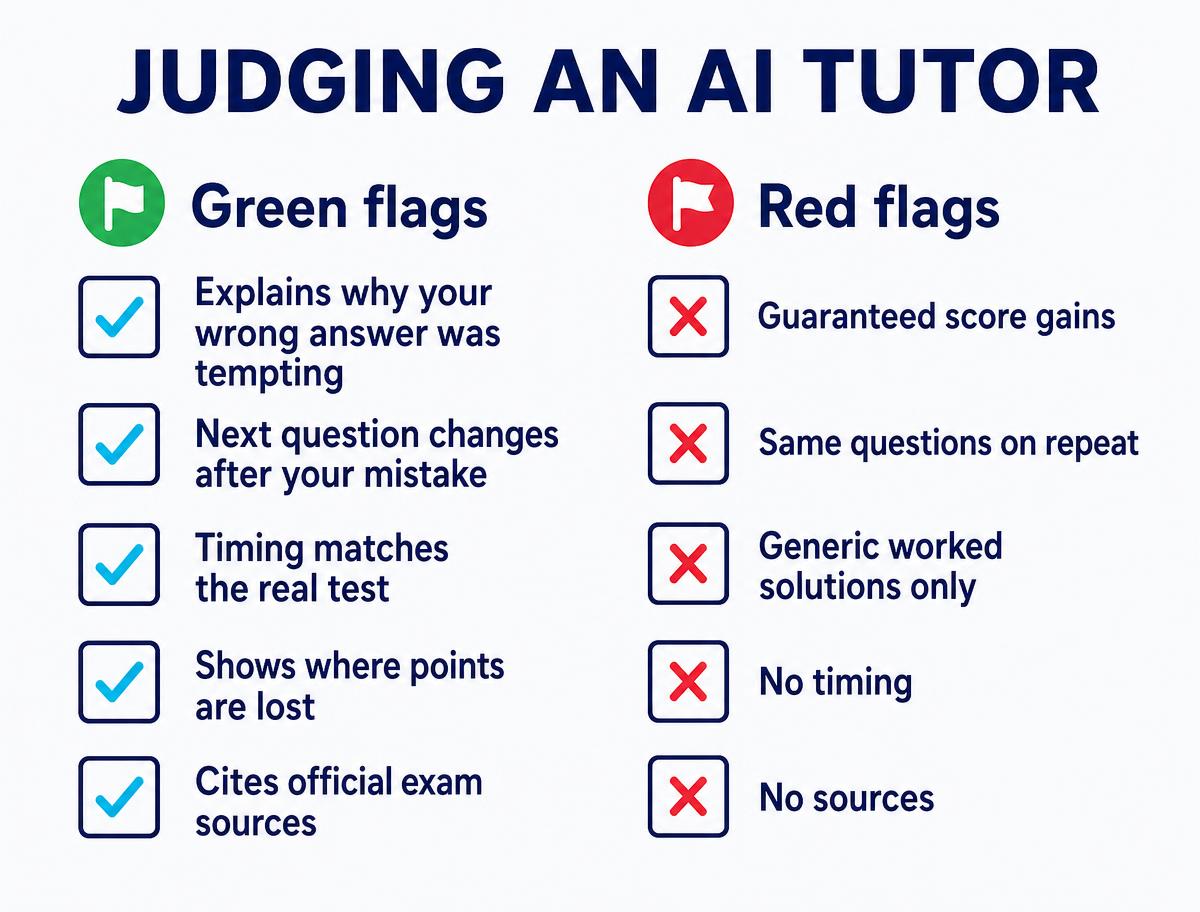
It can also support reflection. Asking why a tempting wrong option fails is often more useful than requesting the correct answer. The student still needs to solve a fresh problem unaided to prove the learning transferred.
Know the limits before trusting the output
Generative systems can produce incorrect explanations, use outdated test rules or create questions that do not match official style. Verify exam policies and format with College Board or ACT. Verify a disputed solution with a trusted source or teacher.
Research on AI tutoring is developing, but evidence from one product, age group or small study cannot establish a guaranteed SAT or ACT score gain. Treat vendor gain claims as marketing unless the method and independent evidence are clear.
“The right question is not “Does it use AI?” It is “Can I verify the explanation, and does the next practice reflect my real errors?””
Use a verify–practice–measure loop
First, verify the explanation and rewrite the method in your own words. Second, solve fresh questions without help. Third, measure whether accuracy and time improve in a mixed timed set. If not, the explanation did not become usable skill.
ExamScore uses performance data to surface weak areas and guide review. That is a product description, not a promise of a particular score increase. Your result still depends on practice quality, starting point, test conditions and many factors outside any platform.
Test whether an AI explanation became a skill
Pick one missed official question and ask the tool to explain why your chosen answer fails. Check the exam rule or disputed step against an official source or a teacher. Then close the explanation and solve a different question using the same idea. Being able to recognize the old worked answer is not the same as being able to solve a new one.
If the explanation gets a fact about the test wrong, stop using it as the authority for exam rules. If the answer checks out but your fresh attempt still fails, ask for a different explanation or go back to the underlying lesson. AI is a review aid, not a substitute for official practice.
- Verify the rule.
- Explain the method in your own words.
- Solve a fresh item unaided and check the result.
Questions people ask
- Can AI help me study for the SAT?
- Yes, mainly for fast explanations of questions you got wrong and for generating extra practice on a weak skill. It works best alongside official practice material rather than instead of it, and every explanation is worth a sanity check.
- How do I know an AI explanation is right?
- Rewrite the method in your own words, then solve two fresh questions of the same type without help. If you cannot, the explanation either was wrong or did not land. Cross-check anything that contradicts official material.
- When is a human tutor the better choice?
- When the real problem is starting at all. If work only happens when someone is expecting it, an appointment with a person solves something no software solves. Also when there is a deeper math or reading gap below the test itself.
AI tutoring and prep options
More in this series
Sources and further reading
Your next useful step
Turn this guide into focused practice.
How this guide is made
Sourced, reviewed and clear about uncertainty.
The ExamScore Editorial Team checks exam facts against the primary sources listed in each guide, labels ExamScore recommendations as guidance, and updates material when official formats or policies change. We do not publish guaranteed score gains.
Continue reading