
The short answer
Choose an AI SAT tutor by checking what happens after you miss a question. A useful system should explain the error, connect it to a skill, assign fresh exam-aligned practice and show whether the mistake stops recurring. The AI label alone proves none of those things.
Key facts
- A useful AI tutor explains why a wrong answer was tempting, not just why the right answer is right.
- Adaptivity means the next question changes because of your last answer, not just a difficulty slider.
- Question depth matters: a small bank gets memorised within weeks.
- Any tool that promises a specific score gain is making a claim it cannot support.
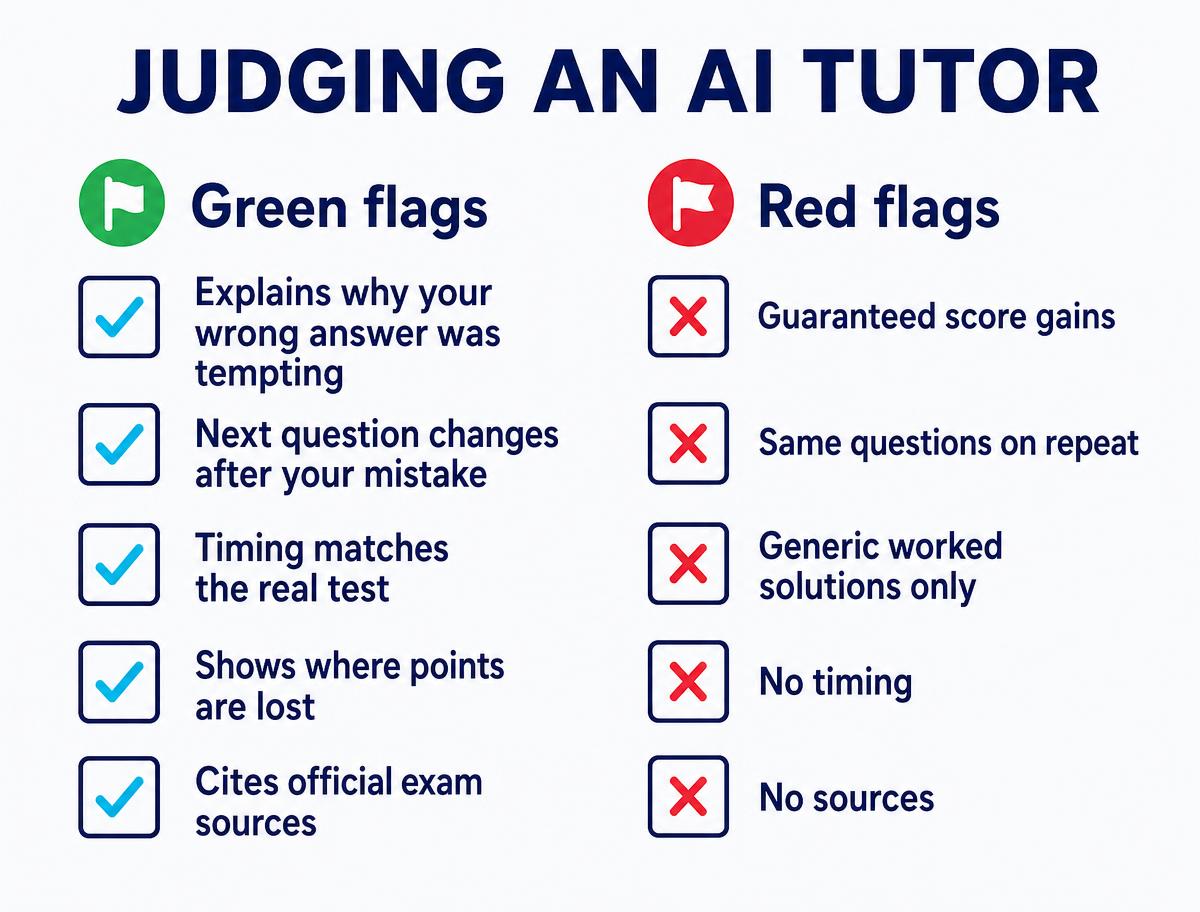
Evaluate the learning loop, not the label
Ask for a complete demonstration: answer a question incorrectly, inspect the explanation, complete the recommended practice and review the resulting progress record. This reveals whether the product teaches or merely chats.
| Check | Useful evidence | Warning sign |
|---|---|---|
| Explanation | Shows why the tempting answer fails | Only reveals the answer |
| Personalization | Uses your actual error history | Calls every response personalized |
| Practice | Maps to current SAT domains | Generic generated questions |
| Measurement | Tracks accuracy and timing on fresh work | A vague mastery percentage |
Keep official practice as the reference point
College Board controls the SAT specification and Bluebook delivery. Use official tests for full-test measurement, then use a tutor to review patterns and fill the practice between those checkpoints.
Confirm that timing, module structure, calculator rules and content domains match current official guidance. AI can explain a rule, but it should not invent the rule.
- Take current official practice tests under realistic conditions.
- Verify disputed exam facts with College Board.
- Prove learning on a fresh question without help.
Match the tool to the problem
AI guidance is most useful when you need frequent explanations, organized error review or a next-practice recommendation. A teacher may be better when anxiety, motivation, accommodations or a persistent conceptual block needs human judgment.
Price also changes the decision. Compare total cost for the period you will study, not an attractive monthly headline that may continue longer than planned.
How ExamScore approaches the job
ExamScore connects explanations and recommendations to practice performance. It is designed to identify topic and timing patterns, then direct the next set of questions.
That is a description of the workflow, not a guaranteed score outcome. Results still depend on the starting point, study consistency, test conditions and how well the student applies the feedback.
“The best AI tutor is the one whose advice you can verify and whose impact you can measure on new work.”
Run the same trial on every tutor
Bring one Reading and Writing miss and one Math miss from a timed set. Ask each tool to explain the tempting wrong choice, suggest a fresh question in the same skill and show where the result appears in your progress record. A polished chat response is not enough if the next practice does not change.
Keep a simple yes-or-no scorecard for exam alignment, explanation quality, fresh practice, progress tracking and total cost through your test date. Ask which answer comes from official material and which is generated. This makes the trial repeatable rather than a reaction to the sales page.
- Test with your own missed questions.
- Check whether feedback points to a specific next skill.
- Confirm the full cost and cancellation terms before paying.
Questions people ask
- What should a good AI SAT tutor actually do?
- Explain your specific mistake, generate fresh practice on that exact weakness, keep timing realistic, and show you where your points are being lost. If it only produces generic worked solutions, a textbook does the same for free.
- How do I test one during a free trial?
- Get three questions deliberately wrong in different skills and read the explanations. Then see whether the next practice it offers targets those skills. That single test separates genuine adaptivity from a shuffled question list.
- What is a red flag?
- Guaranteed score gains, no visible source for exam facts, practice that never changes based on your answers, and timing that does not match the real test. Any one of these means the tool is selling confidence rather than preparation.
AI tutoring and prep options
More in this series
Sources and further reading
Your next useful step
Turn this guide into focused practice.
How this guide is made
Sourced, reviewed and clear about uncertainty.
The ExamScore Editorial Team checks exam facts against the primary sources listed in each guide, labels ExamScore recommendations as guidance, and updates material when official formats or policies change. We do not publish guaranteed score gains.
Continue reading