
The short answer
An AI SAT tutor may be worth it when you practice often but struggle to diagnose mistakes or choose what to do next. It is less valuable if you already review errors well, need human accountability, or have not yet used the free official materials available to you.
Key facts
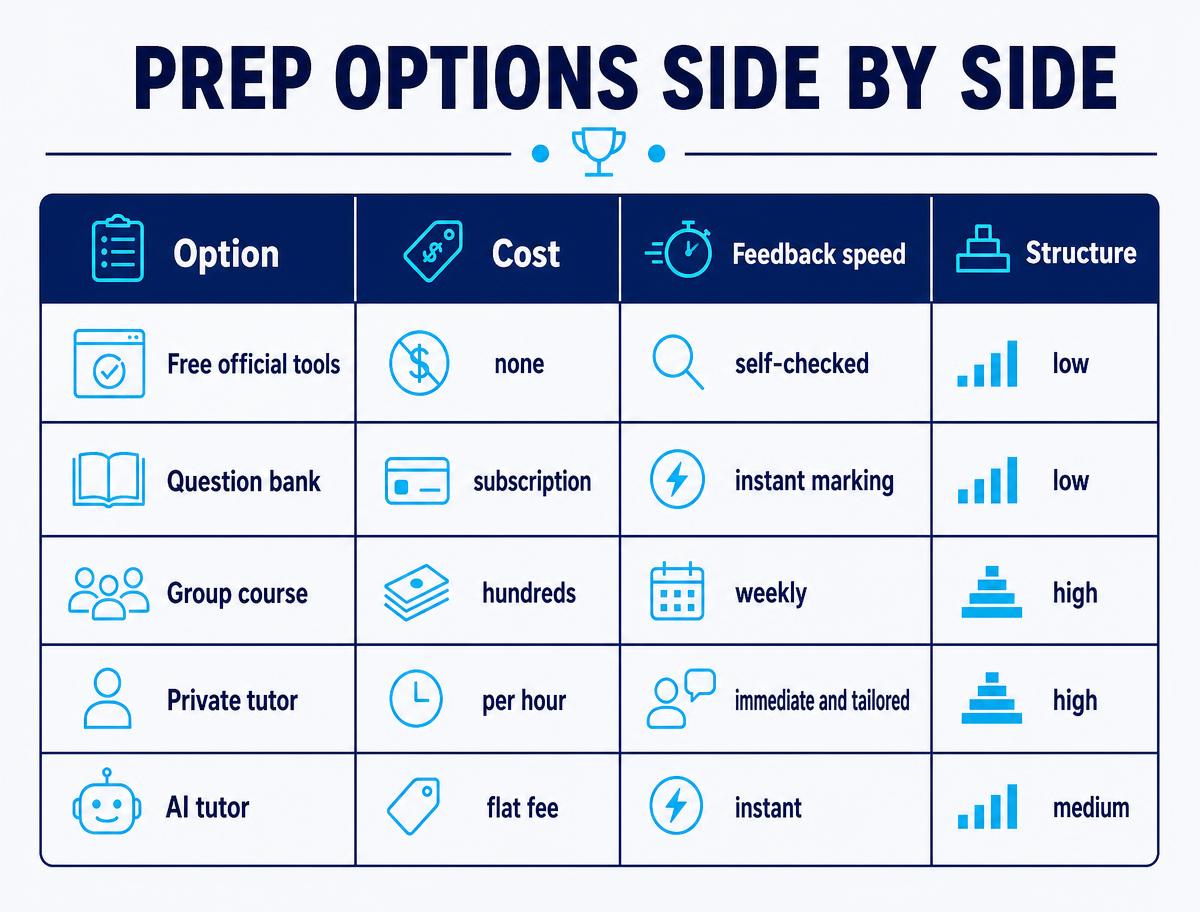
- An AI tutor gives instant feedback at any hour, which a human tutor cannot.
- It does not supply accountability, and for many students that is the missing piece.
- Cost per hour of help is dramatically lower than private tutoring.
- It is a poor fit where the underlying problem is a math or reading gap below test level.
Signs it may be a good fit
The strongest use case is repeated, independent practice that produces more data than the student can organize. AI can group mistakes, offer another explanation and shorten the distance from a report to the next set.
- You need explanations outside scheduled tutoring hours.
- Your practice is broad because you cannot choose priorities.
- The same error types return without being noticed.
- You will verify advice and solve fresh work unaided.
When another option may be better
Use official free practice first if you have not established a baseline. Choose human support when motivation, accommodations, anxiety or a deep conceptual block requires judgment and relationship, not just feedback.
An AI product also cannot make a student practice consistently. Convenience helps, but it does not replace a protected schedule.
Measure value with behavior, not promises
After two weeks, ask whether review is faster, repeated errors are falling and recommended work is specific enough to follow. Do not judge value from time spent in the app or a proprietary score alone.
| Evidence of value | Weak substitute |
|---|---|
| Fewer repeated error types | More messages sent |
| Better accuracy on fresh mixed sets | Recognition of reviewed answers |
| More controlled module pacing | Longer study sessions |
| Clear next-practice decisions | A generic daily streak |
Use a short trial decision
Compare one ordinary study week with one week using the tutor. Keep test conditions and study time similar. If the tool does not improve the quality of review or next-step clarity, it may not solve your actual constraint.
“A tutor is worth paying for only when it changes the quality of learning decisions.”
Choose based on the obstacle, not the technology
If you already sit down to study but keep losing the same type of point, immediate explanations and repeatable practice may be worth paying for. If you cannot start without an appointment, an AI tool cannot supply the human accountability you need. If foundational Math or reading is missing, a teacher may diagnose the gap faster.
Use free official practice first and record the reason for three recent misses. A purchase is justified only when you can say what it will do that the free path did not. Recheck that claim with new timed work after using the tool.
- For missing explanations, try guided review.
- For missing structure, try a scheduled commitment.
- For exam measurement, keep official full-length practice in the plan.
Questions people ask
- Is an AI SAT tutor as good as a human one?
- For explaining a missed question quickly, often yes. For diagnosing a stubborn conceptual gap, reading a student's mood, or making sure the work actually happens, a good human tutor is still ahead.
- Who should not use one?
- Students who only study when someone is expecting them, and students whose real difficulty is a gap from earlier years rather than the test itself. Both need a person before they need software.
- How does the cost compare?
- Private tutoring is charged per hour and adds up quickly. An AI tutor is a flat cost for unlimited use, so the more you use it the cheaper each hour of help becomes. That math only helps if you actually use it.
AI tutoring and prep options
More in this series
Sources and further reading
Your next useful step
Turn this guide into focused practice.
How this guide is made
Sourced, reviewed and clear about uncertainty.
The ExamScore Editorial Team checks exam facts against the primary sources listed in each guide, labels ExamScore recommendations as guidance, and updates material when official formats or policies change. We do not publish guaranteed score gains.
Continue reading