
The short answer
PSAT and SAT scores are placed on a common vertical scale, so the same score represents a similar level of achievement. But a PSAT score is not a guaranteed future SAT score: time, preparation, test conditions and the SAT's higher ceiling all matter.
Key facts
- The PSAT/NMSQT is scored from 320 to 1520, using the same underlying scale as the SAT.
- A PSAT score indicates a range, not a fixed SAT prediction.
- National Merit recognition uses a Selection Index, not the total score.
- Selection Index cutoffs vary by state and change from year to year.
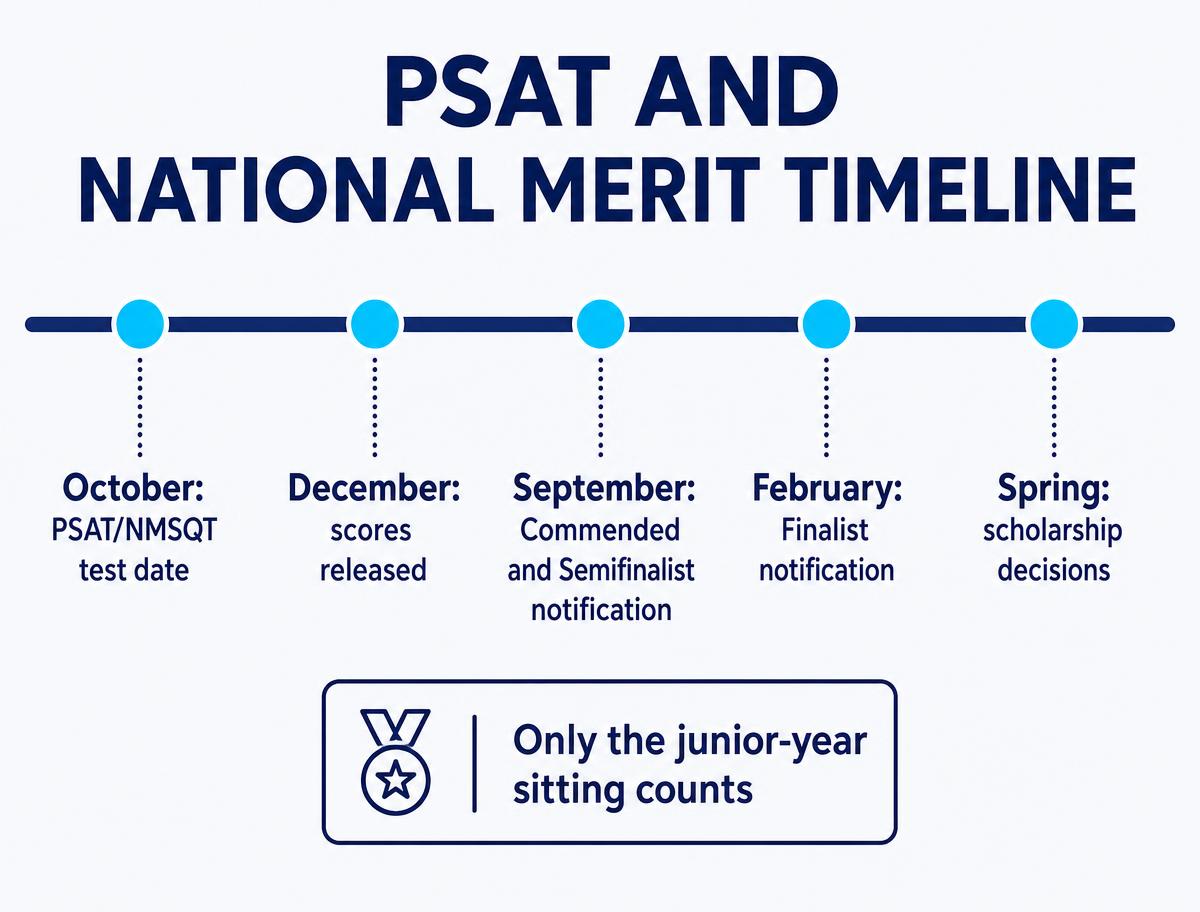
Selection Index is a separate calculation
National Merit Scholarship Corporation uses a Selection Index, not the 320–1520 total by itself. On the PSAT/NMSQT score report, the index is calculated by doubling the sum of the Reading and Writing section score divided by 10 and the Math section score divided by 10.
| Result | Purpose | Important limit |
|---|---|---|
| PSAT total | Overall achievement on the 320–1520 scale | Not the National Merit qualifying number |
| Section scores | Reading and Writing plus Math performance | Need to inspect the section balance |
| Selection Index | National Merit program screening | Qualifying levels vary by year and location |
Do not treat projected cutoffs as official
Commended and Semifinalist decisions depend on the program's annual process. State cutoff estimates published before official notification are projections, even when based on historical patterns. Use the National Merit Scholarship Corporation and your official score information for final status.
A strong PSAT result can guide scholarship planning, but it should not replace checking eligibility, entry requirements and current deadlines directly.
Use the PSAT result to plan the SAT
Compare the two section scores first. Then identify two or three content domains that repeatedly caused misses. Build a focused cycle and take a full digital SAT diagnostic after enough practice to make the comparison meaningful.
The SAT includes a slightly higher score ceiling, but the digital interface and core section structure are closely related. Interface fluency, pacing habits and error review carry across.
A worked example without a fake conversion
Imagine a PSAT report showing 650 in Reading and Writing and 610 in Math. The total is 1260 on the PSAT's 320–1520 scale. That tells you Math is the lower section today; it does not say your SAT will be 1260, or that adding 80 points produces a valid SAT forecast.
To make a plan, inspect the Math content domains behind that 610, practice the repeatable misses, then sit an official full-length SAT practice test under timing. Compare its Math result with your PSAT section pattern rather than treating a conversion table as a target.
- Use the PSAT section split to choose an initial study priority.
- Use an SAT practice test to establish an SAT baseline.
- Read the Selection Index separately if National Merit matters to you.
Questions people ask
- Does the PSAT predict my SAT score?
- It provides a starting point, not a prediction or a fixed conversion. The two tests share a score scale, but preparation, growth and test-day conditions can all change your eventual SAT result. Use a timed SAT practice test to set a more useful baseline.
- What is the Selection Index?
- It is a score built from your Reading and Writing and Math results, used by the National Merit Scholarship Corporation rather than by colleges. It is calculated differently from your total PSAT score, which is why a strong total does not automatically mean recognition.
- Is a good PSAT score worth anything on its own?
- For college admissions, no. Colleges do not see PSAT scores. Its value is as a free, realistic baseline and, for a small group of high scorers, as the route into National Merit recognition.
PSAT and National Merit
More in this series
Sources and further reading
Your next useful step
Turn this guide into focused practice.
How this guide is made
Sourced, reviewed and clear about uncertainty.
The ExamScore Editorial Team checks exam facts against the primary sources listed in each guide, labels ExamScore recommendations as guidance, and updates material when official formats or policies change. We do not publish guaranteed score gains.
Continue reading