
The short answer
AI can support TMUA preparation by explaining reasoning steps, classifying errors and generating follow-up prompts. Official specifications and practice papers must remain the reference, and every generated solution should be checked because subtle mathematical errors can look convincing.
Key facts
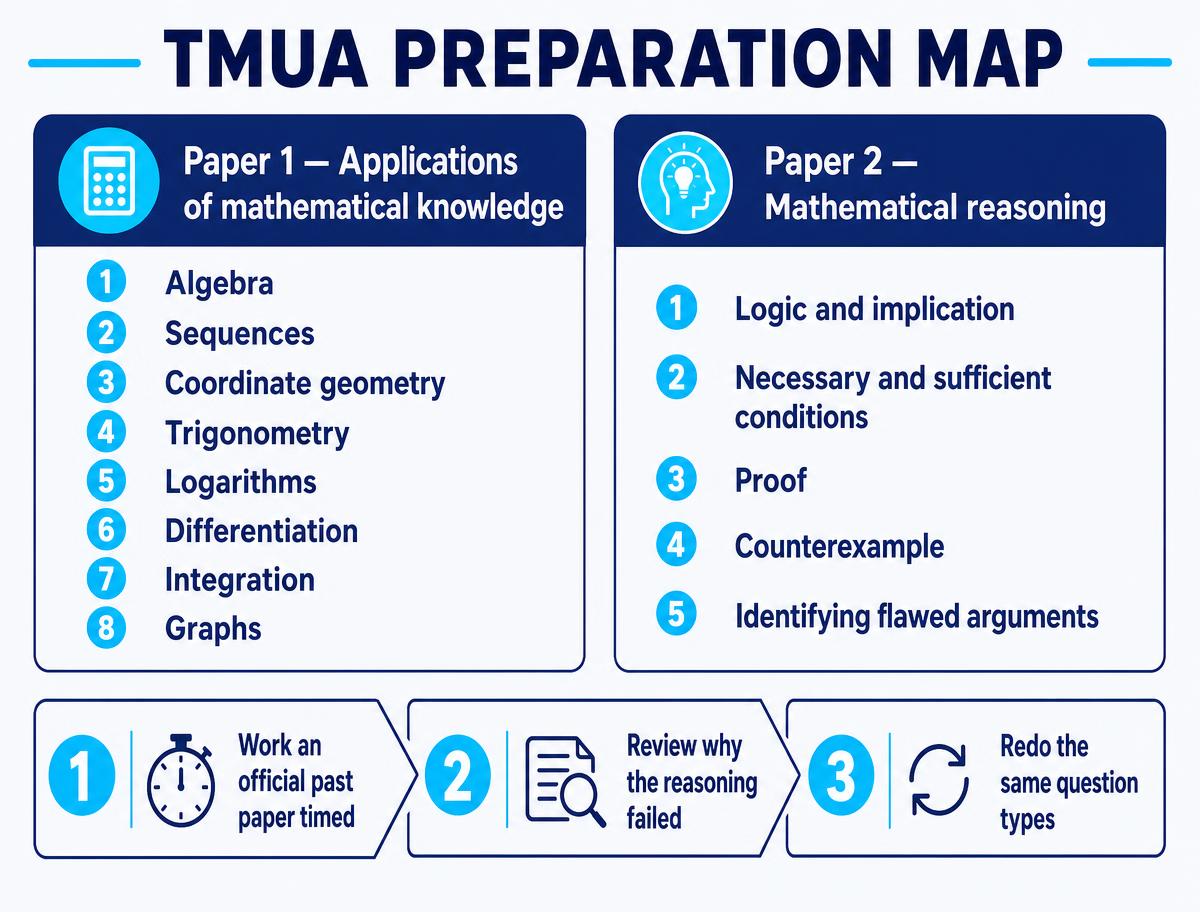
- The TMUA has two papers: applications of mathematical knowledge, and mathematical reasoning.
- It tests reasoning within familiar school mathematics rather than new content.
- Some universities use the TMUA to inform offers; requirements vary by course.
- Official past material from the test's administrator is the reliable reference point.
Give AI a narrow, verifiable role
Use it to compare solution paths, ask for a hint, or identify the assumption behind a mistake. Avoid outsourcing the whole solution before attempting the problem; recognition is not the same as producing reasoning under pressure.
Use an attempt–hint–verify loop
Attempt the problem under the relevant conditions. If blocked, request the smallest useful hint. Finish independently, then verify the reasoning against an official solution or a trusted mathematics source.
- Write the first approach before asking for help.
- Request one hint rather than a full answer.
- Explain the corrected proof or method aloud.
- Solve a related problem without assistance.
Build preparation around mathematical decisions
Classify errors by concept, representation, logical step, algebra and time management. Then practice related problems in mixed sets so the method must be selected rather than announced.
| Error | Useful AI prompt | Proof of learning |
|---|---|---|
| Concept | Explain the definition with a counterexample | Apply it in a new context |
| Logic | Identify the first unsupported step | Rewrite the argument |
| Algebra | Find the transformation error only | Complete a parallel problem |
| Timing | Suggest a quicker recognition cue | Use it in a timed set |
Protect against confident mathematical errors
Check notation, domain restrictions and hidden assumptions. If an AI explanation conflicts with official material, use the official source. Exam policies and specifications can also change, so verify them at the source before each application cycle.
“For TMUA, a plausible explanation is not enough; every step must survive verification.”
Practice both papers in the current delivery format
UAT-UK administers the TMUA, which is delivered at Pearson VUE test centers. Start with UAT-UK's own preparation materials and instructions. Work a timed Paper 1 and Paper 2 separately: one missed question may reveal an algebra gap, while another may reveal a faulty implication or counterexample.
If an AI tool proposes a proof, identify every assumption and test a counterexample before accepting it. Use the official answer and explanation where available to settle disagreements. Familiarity with the computer-based test process matters as well as mathematical fluency.
- Check current UAT-UK registration and test-day guidance.
- Classify errors by knowledge versus reasoning.
- Do not trust an AI-generated proof without checking each step.
Questions people ask
- How should I prepare for the TMUA?
- Work through current UAT-UK preparation materials under time. Review both papers separately: identify missing mathematical knowledge in Paper 1 and reasoning steps you cannot justify in Paper 2. Check current computer-based test instructions before test day.
- What does the reasoning paper test?
- Logical structure: implication, necessary and sufficient conditions, proof and counterexample. The mathematics involved is usually familiar. The difficulty is in following and evaluating an argument precisely under time pressure.
- Can AI help with TMUA preparation?
- It can explain a step you could not follow and generate similar reasoning problems. Check anything it claims against official material, because reasoning questions are exactly where a confident wrong explanation does the most damage.
Sources and further reading
Your next useful step
Turn this guide into focused practice.
How this guide is made
Sourced, reviewed and clear about uncertainty.
The ExamScore Editorial Team checks exam facts against the primary sources listed in each guide, labels ExamScore recommendations as guidance, and updates material when official formats or policies change. We do not publish guaranteed score gains.
Continue reading