
The short answer
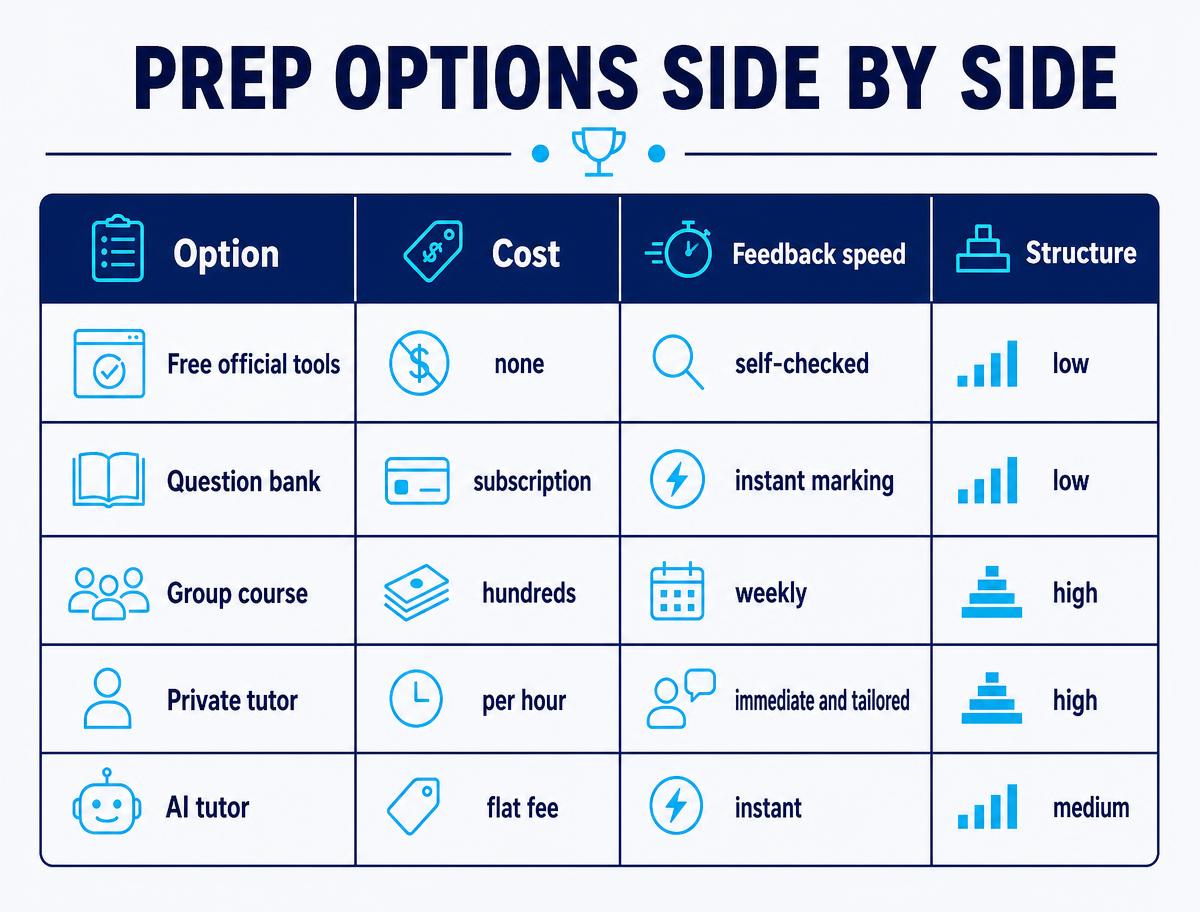
The right SAT prep depends on your timeline, your budget, how self-directed you are and what your last practice test showed. Answer the four questions below for a place to start. For many students, free official practice is enough.
Key facts
- For most students the honest first answer is the free official path.
- Budget, time remaining, starting score and self-direction decide the rest.
- Under four weeks to the test, prioritize timed full-length practice over new content.
- Paying more does not reliably produce a bigger gain.
Four-question prep picker
Answer all four for a starting suggestion. Nothing is stored and no account is needed.
How the suggestion is made
The picker applies a simple, fixed rule set to your four answers. It runs entirely in your browser, stores nothing and asks for no account. It is a starting suggestion, not a diagnosis, and it cannot predict a score.
If two options feel close, choose the cheaper one first and upgrade only after a full study cycle shows it is not working.
The rules behind the suggestion
These are ExamScore recommendations based on how the options differ, not official guidance from any test maker.
| Signal | Suggested direction | Why |
|---|---|---|
| 12+ weeks, self-directed, low budget | Free official path | Time plus discipline makes paid structure unnecessary |
| Short timeline, unclear weak areas | Analytics-led platform | Diagnosis matters more than more lessons |
| Struggles to start sessions | Course or tutor | You are buying accountability |
| Strong content, weak pacing | High-volume timed practice | Repetition under timing is the fix |
| Anxiety or a persistent block | Human tutor | Judgement no software provides |
After you choose
Whatever you pick, keep two fixed points: a full-length official test as your benchmark and an error log that records why each point was lost. Those two habits do more than the choice of provider.
Review the decision once, after four weeks. If nothing has moved and the error categories are unchanged, change the layer you added rather than adding another.
“A cheaper plan you complete beats an expensive plan you abandon.”
Check whether the recommendation worked
The picker uses your time, budget and study habits to suggest a starting route. It cannot observe your actual work. If it recommends free official practice, take a timed Bluebook test and use the result to choose a skill to practice on Khan Academy. If it recommends added support, trial that option on a specific repeated error.
After one study cycle, compare fresh timed work with your baseline. If accuracy improves but you still run out of time, adjust pacing practice rather than buying another explanation tool. If you still do not study consistently, change the schedule or accountability before adding content.
- Write down why the route was recommended.
- Use a timed baseline and a comparable checkpoint.
- Change the support only when the evidence points to a different obstacle.
Questions people ask
- How do I choose between all the SAT prep options?
- Answer four questions: how long until the test, what your starting score is, what you can spend, and whether you reliably study without someone checking. Those four answers eliminate most of the options for you.
- What if I have no budget?
- Free official practice in Bluebook plus Khan Academy's official course covers the syllabus and gives realistic tests. That path is genuinely sufficient for a lot of students, and it is where everyone should start regardless of budget.
- What if I only have four weeks?
- Stop trying to cover everything. Sit a timed full-length test, fix the two skills losing the most points, and take another timed test each week. Broad content revision this close to the date rarely shows up in the score.
AI tutoring and prep options
More in this series
Sources and further reading
Your next useful step
Turn this guide into focused practice.
How this guide is made
Sourced, reviewed and clear about uncertainty.
The ExamScore Editorial Team checks exam facts against the primary sources listed in each guide, labels ExamScore recommendations as guidance, and updates material when official formats or policies change. We do not publish guaranteed score gains.
Continue reading